Showing posts with label Mathematics. Show all posts

Thursday, January 21, 2010

The Enjoyment of Math


The Enjoyment of Math
PDF | 216 pages | 14.68 MB

A thoroughly enjoyable sampler of fascinating mathematical problems and their solutions. Each chapter is a gem of mathematical exposition.... [The book] will not only stretch the imagination of the amateur, but it will also give pleasure to the sophisticated mathematician.


Sunday, December 6, 2009

Kerala Mathematics : History And Its Possible Transmission To Europe


Kerala Mathematics : History And Its Possible Transmission To Europe
by George Gheverghese Joseph
328 pages | PDF | 104 MB

In the history of mathematics the invention of calculus and the passage to infinity are seen as major benchmarks in the creation of modern or advanced mathematics. A principal focus of this volume is tracing the beginnings of modern mathematics to India notably Kerala and how these ideas and techniques may have been transmitted to Europe.
It such transmission proves to be significant it would help to deconstruct the prevailing Eurocentric account of the development of modern mathematics. To that end invitations were extended to a group of distinguished historians mathematicians educators linguists philosophers and others to make presentations at a two day workshop held in Trivandrum.
And this is reflected in the breadth and depth of the papers presented in this volume.


Friday, November 20, 2009

Mathematics: Applications and Concepts, Course 3, Student Edition


Mathematics: Applications and Concepts, Course 3, Student Edition
 PDF | 82,41 MB

Mathematics: Applications and Concepts sets the standard in Middle School mathematics. This three-course program provides a unique blend of instruction, daily practice, intervention, standardized test preparation, and practice in reading and writing math, and gets students ready for testing success.


Download Link

Navigating Through Algebra in Grades 3-5


Navigating Through Algebra in Grades 3-5
 PDF | 51.2 MB | 90 Pages

The important ideas of algebra, including patterns, variables, equations, and functions, are the focus of this book. Student activities that introduce and promote familiarity with these ideas include constructing growing patterns using isosceles triangles, analyzing situations with constant or varying rates of change, and observing and representing various patterns in an array. The supplemental CD-ROM features interactive electronic activities, master copies of activity pages for students, and additional readings for teachers (only the additional readings for teachers are included in the link).


Download Link

Designing Mathematics for Science Curriculum Programs:


Designing Mathematics for Science Curriculum Programs:
A Guide for Using Mathematics and Science Education Standards
 70 pages | PDF | 0.5MB

With the publication of the National Science Education Standards and the National Council of Teachers of Mathematics' Curriculum and Evaluation Standards for School Mathematics, a clear set of goals and guidelines for achieving literacy in mathematics and science was
established. Designing Mathematics or Science Curriculum Programs has been developed to help state- and district-level education leaders create coherent, multi-year curriculum programs that provide students with opportunities to learn both mathematics and science in a connected and cumulative way throughout their schooling.

Researchers have confirmed that as U.S. students move through the grade levels, they slip further and further behind students of other nations in mathematics and science achievement Experts now believe that U.S. student performance is hindered by the lack of coherence in the mathematics and science curricula in many American schools. By structuring curriculum programs that capitalize on what students have already learned, the new concepts and processes that they can learn will be richer, more complex, and at a higher level. Designing
Mathematics or Science Curriculum Programs outlines:

* Components of effective mathematics and science programs.
* Criteria by which these components can be judged.
* A process for developing curriculum that is structured, focused, and coherent.
Perhaps most important, this book emphasizes the need for designing curricula across the entire 13-year span that our children spend in elementary and secondary school as a way to improve the quality of education. Ultimately, it will help state and district educators use national and state standards to design or re-build mathematics and science curriculum programs that develop new ideas and skills based on earlier ones--from lesson to lesson, unit to unit, year to year.

Anyone responsible for designing or influencing mathematics or science curriculum programs will find this guide valuable.


Download Link

Group Theory


Introduction to Group Theory
European Mathematical Society | ISBN 3037190418 | 2008-03-15
PDF | 187 Pages | 3 MB

This book quickly introduces beginners to general group theory and then focuses on three main themes : finite group theory, including sporadic groups combinatorial and geometric group theory, including the Bass-Serre theory of groups acting on trees the theory of train tracks by Bestvina and Handel for automorphisms of free groups With its many examples, exercises, and full solutions to selected exercises, this text provides a gentle introduction that is ideal for self-study and an excellent preparation for applications.

A distinguished feature of the presentation is that algebraic and geometric techniques are balanced. The beautiful theory of train tracks is illustrated by two nontrivial examples. Presupposing only a basic knowledge of algebra, the book is addressed to anyone interested in group theory: from advanced undergraduate and graduate students to specialists.


Theory and Problems of Tensor Calculus


Theory and Problems of Tensor Calculus
224 pages | PDF | 16,9 MB

This lucid introduction for undergraduates and graduates proves fundamental for practitioners of theoretical physics and certain areas of engineering, like aerodynamics and fluid mechanics, and exteremely valuable for mathematicians. This study guide teaches all the basics and efective problem-solving skills too.


Discrete Mathematics DeMYSTiFied


Discrete Mathematics DeMYSTiFied
364 pages | PDF | 4,5 MB

If you're interested in learning the fundamentals of discrete mathematics but can't seem to get your brain to function, then here's your solution. Add this easy-to-follow guide to the equation and calculate how quickly you learn the essential concepts.

Written by award-winning math professor Steven Krantz, Discrete Mathematics Demystified explains this challenging topic in an effective and enlightening way. You will learn about logic, proofs, functions, matrices, sequences, series, and much more. Concise explanations, real-world examples, and worked equations make it easy to understand the material, and end-of-chapter exercises and a final exam help reinforce learning.

This fast and easy guide offers:
Numerous figures to illustrate key concepts
Sample problems with worked solutions
Coverage of set theory, graph theory, and number theory
Chapters on cryptography and Boolean algebra
A time-saving approach to performing better on an exam or at work
Simple enough for a beginner, but challenging enough for an advanced student, Discrete
Mathematics Demystified is your integral tool for mastering this complex subject.


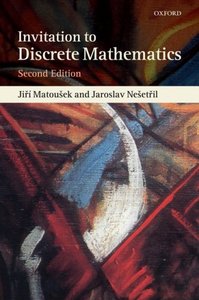
An Invitation to Discrete Mathematics


An Invitation to Discrete Mathematics
456 pages | PDF | 3,7 MB

This book is a clear and self-contained introduction to discrete mathematics. Aimed mainly at undergraduate and early graduate students of mathematics and computer science, it is written with the goal of stimulating interest in mathematics and an active, problem-solving approach to the presented material. The reader is led to an understanding of the basic principles and methods of actually doing mathematics (and having fun at that). Being more narrowly focused than many discrete mathematics textbooks and treating selected topics in an unusual depth and from several points of view, the book reflects the conviction of the authors, active and internationally renowned mathematicians, that the most important gain from studying mathematics is the cultivation of clear and logical thinking and habits useful for attacking new problems.

More than 400 enclosed exercises with a wide range of difficulty, many of them accompanied by hints for solution, support this approach to teaching. The readers will appreciate the lively and informal style of the text accompanied by more than 200 drawings and diagrams. Specialists in various parts of science with a basic mathematical education wishing to apply discrete mathematics in their field can use the book as a useful source, and even experts in combinatorics may occasionally learn from pointers to research literature or from presentations of recent results. Invitation to Discrete Mathematics should make a delightful reading both for beginners and for mathematical professionals.

The main topics include: elementary counting problems, asymptotic estimates, partially ordered sets, basic graph theory and graph algorithms, finite projective planes, elementary probability and the probabilistic method, generating functions, Ramsey's theorem, and combinatorial applications of linear algebra. General mathematical notions going beyond the high-school level are thoroughly explained in the introductory chapter. An appendix summarizes the undergraduate algebra needed in some of the more advanced sections of the book.


Friday, November 6, 2009

Learning to Teach Mathematics in the Secondary School:


Learning to Teach Mathematics in the Secondary School:
A Companion to School Experience
PDF | 278 Pages | 2.18 MB

This British textbook for pre-service secondary mathematics teachers gives information about current educational theories and trends. It is a survey textbook that covers curriculum goals, the English and Welsh national curriculum, learning theories, lesson design, assessment, communication, technology, special education, and the broader context of mathematics education.


Mathematics for the IB Diploma


Mathematics for the IB Diploma
PDF | 816 Pages | 9.87MB

This book is intended for the "IB Mathematics" course at Diploma level. It is expected that this book will be used over a two year period. There are plenty of worked examples with step by step explanations, problems are carefully structured and investigations appear throught. Revision exercises are given at the end of each chapter, and answers to the exercises and index appear at the end of the book.

This package also include the contents of the CD accompanying with this book. In this changing world of mathematics education, the contextual approach shown in this book, with the associated use of the technology, will enhance the students' understanding, knowledge and appreciation of mathematics, and its universal application.


Monday, November 2, 2009

Master Math - Algebra


Master Math - Algebra
PDF | 189 Pages | 3.81 MB

Master Math: Algebra makes the transition form pre-algebra smooth and stress-free. This math reference guide makes learning and understanding algebraic equations, inequalities, polynomials and linear equations as simple as “two plus two.”


Tuesday, October 20, 2009

The Princeton Companion to Mathematics


The Princeton Companion to Mathematics
PDF | 1009 Pages | 8.75 MB

Once in a while a book comes along that should be on every mathematician's bookshelf. This is such a book. Described as a 'companion', this 1000-page tome is an authoritative and informative reference work that is also highly pleasurable to dip into. Much of it can be read with benefit by undergraduate mathematicians, while there is a great deal to engage professional mathematicians of all persuasions.


Edited by Gowers, a recipient of the Fields Medal, this volume contains almost 200 entries, commissioned especially for this book from the world's leading mathematicians. It introduces basic mathematical tools and vocabulary, traces the development of modern mathematics, defines essential terms and concepts, and puts them in context. . . . Packed with
information presented in an accessible style, this is an indispensable resource for undergraduate and graduate students in mathematics as well as for researchers and scholars seeking to understand areas outside their specialties.